It is true that all measurements are relative. This must be true simply because a measurement is a comparison, a relative measure. But if you cross check ("transverse") and verify your measurements then correct for consistency and cohesiveness, you discover absolute measure that is the same for all. Thus measurements are only relative when you don't cross verify them and correct for the logical inconsistencies.
The following is an example of literally "cross" verifying so as to either correct for irrational conclusions, or be forced to accept even more irrational conclusions.
If we get on a train and time the train’s travel over 1000 meters, we can calculate the train’s velocity;
v = dx/dt
But if our watch is running slow, we will measure incorrectly and think the train was going faster than it really was.
v’ = dx/dt’
We know that when something moves very quickly, its clocks will run slower. So we know that we don’t have to have a broken clock for us to measure the wrong velocity. But the equation v’ = dx/dt’ requires that we make a choice that either our velocity measured, v’ is wrong or the length of the track has shortened, dx’, just because we were moving.
Lorentz
The Lorentz equations seem to have chosen to say that our distance has “really” shortened rather than say that we are merely experiencing the effects of a slower clock thus not measuring the “real” velocity. Why is that?
The result of this choice is that we have “relativity of simultaneity” saying that someone will think that 2 events happened at the same time while another thinks they happened at different times rather than having someone think he was going at one speed and another thinks that he was going at a different speed.
The Lorentz equations assume there is a "real" velocity thus there cannot be a "real" length.
Is there some reason for that Lorentz/Einstein choice?
Transverse Spin Counter
If we mount a transverse spin counter on the train and count the number of transverse spins during the train’s 1000 meter run, the Lorentz equations will yield the same number of spins as anyone at the station would count for that same length of time, especially if it is optic, because transverse time isn’t effected by linear inline motion and certainly optic time isn't. The spin counter would cross check and correct for the time dilated slower clock and measure the correct velocity.
So can we say that if a train has a spin counter on it, its length, “dx’ “ doesn’t dilate and thus when it believes things are simultaneous they really will be?
Our other choice is to say that due to Lorentz equations we must accept “relativity of count” wherein our otherwise unaffected count of anything will have to change merely because we were moving (maybe now we know where that missing passenger went?).
Always carefully cross check what is in the Coolaid.
==============================================================
The Lorentz equations for calculating time and distance effects of motion have been around for over 100 years. They have always assumed that there is only one velocity measured by both moving and non-moving objects and declare that both time and distance must change to account for it. Time certainly does change in measurement for moving objects, but change in measured distance rather than measured velocity?
If we choose instead to assume that the velocity of the train were seen as being different as measured by the train rather than the distance, our spin counter would count the same for either and thus resolve this puzzle. But if we were to do that, think how many equations would have to change. Did anyone say, “job shortage”?
Always very carefully check what is in the Coolaid.
Now go back and resolve the Stopped Clock Paradox.
Wednesday, September 15, 2010

Monday, September 6, 2010
Resolve to the Twins Paradox – Frame of Origin
I have read many arguments concerning the issue of the famed “Twin Clock Paradox”. Very many arguments go through considerably complex explanations so as to defend Special Relativity or dispute it. But the explanation is actually much simpler.
In every proposed twins paradox, there is a Frame of Origin. The frame of origin is where the twins were at rest with respect to each other and to where they return. In the original scenario, that was “the Earth” and is referred to as “the inertial frame”.
It is called “the inertial frame” because it is the one frame declared “inertial; not movable”. But the issue comes to mind as to how either frame can be considered the one that isn’t moving. SR declares that such a notion is irrelevant. But if it is ignored, an apparent paradox arises.
So as to clear up the picture a bit, let’s presume that neither twin stands perfectly still, but rather one twin (Twin A) just very minutely drifts away from the Frame of Origin while the other twin (Twin B) takes off in his ultra fast rocket. This is merely to provide distinction and reveal that there are always 3 frames involved.
And further, so as to get away from the complexities of gravitation issues, lets put them out in space originally standing on a small floating space station far away from any gravity field.
The time dilation factor is always applied to whichever one leaves the Frame of Origin.

Twin B gets in his rocket and rockets away. Twin A gets into his rocket and sticks ores out his windows and begins to row hoping to catch a few gas particles drifting by from Twin B’s exhaust.
If we apply the time dilation to the one doing all of the serious moving, Twin B’s clock will run slower and he will age less. We cannot simply reverse the reasoning and say that it is all relative because Twin A is not moving away from the Frame of Origin.
That is pretty much the end of the story, but…
Some scenarios remove any sign of the Frame of Origin so as to make their point clear. The problem is that in every case, there must always be a Frame of Origin where their clocks were staying in sync whether anything is standing as a sign of it or not. If two items are moving away from each other, there must be a frame indicating a synchronized clock situation. The issue becomes how to find out where that frame would be.
If the ships merely see nothing but each other separating, they might not know which is accelerating from the Frame of Origin, but that is only a matter of their awareness. If they later find that one has greater time dilation than the other, it can be deduced as to which was accelerating more from the Frame of Origin.
If they see no difference in their clocks, then they can deduce that they were both leaving the Frame of Origin merely in different directions.
Without determining the Frame of Origin, the Twins cannot know which of them will age more until they meet again.
Thursday, August 26, 2010
Stopped Clock Paradox
I would like to introduce what I believe to be a new paradox involving relativity and twin stop clocks. The only mathematics needed to follow along is simply, “if A = B and B = C, then A = C”. The only physics required is the basic idea of relativity and that a photon is a singular bundle of light.
The Clocks
Two clocks are designed identically such that if two photons simultaneously strike receptor cells attached to each clock, the clocks will stop. One, the station clock, is mounted above the tracks at a train station. The other, the train clock, is mounted such as to be in the exact center of an opened-top railcar on the train (by the train’s reference frame) when the moving railcar is centered about the station clock at 4:00-t (by the station’s reference frame).
The twin clocks are then sufficiently desynchronized so as to allow for them both to read exactly 4:00-t o’clock when the train passes the station and the clocks are transversely inline. This of course must be done considering the laws of relativity concerning the acceleration and speed of the train and the effect of that upon its clock. The alternative is merely to accomplish the simultaneity of the clock’s timing by trial an error.
The Flashers
But in addition to the clocks, two photon flashers are mounted on the railcar walls, one on the front and one on the rear walls. Each photon flasher also has a clock identically timed to match the centered train clock at 4:00-t.
Also each flasher is set to fire 2 photons toward the center of the railcar at exactly 4:00 o’clock minus the calculated time for a photon to travel to a centered clock (t). The objective being to have the photons stop each clock at exactly 4:00 o’clock. So with each flasher, one of its photons is aimed slightly upward toward the receptor cell of the station clock and the other slightly downward at the same angle reversed to meet the receptor cell of the train clock.


If the railcar could instantaneously stop at 4:00-t, all four photons would strike a receptor cell at exactly the same time and at exactly 4:00 o’clock. But since the train doesn’t stop, a question comes to mind as to which clocks will be stopped by the simultaneous photon strikes and at what time.
All photons involved are sourced from two equally moving flashers at 4:00-t. The front flasher releases two identical photons that have no reason to travel at different velocities from each other. The back flasher photons similarly have no reason to travel at different velocities than each other. And none of the photons have any means to know of or vary due to being inside or outside of the railcar.
It is speculated that a photon, like a radio wave, travels independently of its source and thus all four photons must travel at the exact same velocity covering the exact same distance in the same amount of time and regardless of which direction the flashers were moving or which frame of reference is used to take the measurements as long as only one is used.
Relativity
Galilean invariance or Galilean relativity is a principle of relativity that states that the fundamental laws of physics are the same in all inertial frames and lead to Einstein’s Special and General relativity theories. What this principle means in this example is that no matter which frame of reference is used as the designated inertial frame to measure the paths of the photons (on the moving train or at the station) all four photons must be measured to travel the exact same distance over the same amount of time (t).
Relativity of Simultaneity
In this scenario, the flashers are already set to be identical and in sync at 4:00-t station clock time. Nothing comes from either frame to set them off as they have their own internal clocks, thus the relativity of simultaneity doesn't get involved and doesn't apply.
The simultaneity of the flashes is guaranteed for both frames due to the predesigned simultaneity through whatever means is necessary to ensure they flash at exactly 4:00-t as measured by both clocks and their internal clocks. Neither flasher has impetus to flash before the other from either reference frame. Thus both reference frames would see a simultaneous flash from the two flashers as by design, there is never an opportunity for the flashers to become asynchronous or misaligned with respect to either reference frame.
If you are one of the many who have become confused regarding relativity of simultaneity and believe that the Lorentz equations demand that the train and the station cannot both see the flashes as simultaneous, consider that such has merely been a misunderstanding of how to use the Lorentz equations. Einstein remarked that due to the time it took light to travel from different sources, one person might come to believe that two events were simultaneous even though they were not. And consider the following;
In the following pictorials, two trains are first shown traveling the distance ∆x in the time ∆t. A clock is tossed onto each train, then photo flashed ∆t time later. The image of the train’s clock faces are reflected from each clock displaying their time reading at that moment and seen by everyone regardless of their distance from the flash. Each person will see the image at a different time, but there is only one image to be seen.
In the third portion of the pictorial, the two train’s are combined into one, showing that each clock face will still show the same time to anyone.

But since there is only one image to be seen regardless of which clock face and that image is broadcast everywhere, on board the train, the same image is seen as the train's clocks readings.
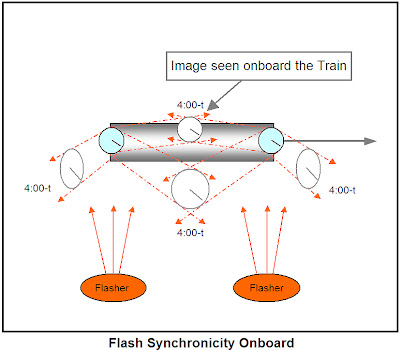
So far, the flashers at the station have been used to produce the flash and thus light has traveled from the flashers to the train clocks. But the direction of the light from the light source hasn’t anything to do with the synchronicity of the clocks, so if we have the clocks flash their face image at that moment instead of the station flashers, we would get the same image.

It is clear that all, on board the train and off, will see the same image of the synchronized clocks on the train.
The flash timers mentioned in the paradox are clocks that flash at a given time setting, “4:00-t”. If they were to show their clock face as a flash, everyone would see the same image of “4:00-t” from both clocks whether on board the train or off. The train timers and clock are therefore synchronous in both frames. The question in the paradox isn’t what will be seen, but when it will be seen.
Summery of the Setup
To summarize the scenario setup, let me go through it again with less explanation.
A station clock is set so that at 4:00-t a railcar will be passing by. On that railcar, fore and aft, two flashers are set to go off exactly when the station clock will be reading 4:00-t and when they are equal distance from the station clock with respect to the station clock’s reference frame. So by design, both flashers trigger at exactly 4:00-t as indicated by the station clock.
Also aboard the train, a train clock is set to be exactly centered between the two flashers by its own reference frame when the station clock reads 4:00-t regardless of how the station reference frame might view it. The train clock is then adjusted so that it too will read exactly 4:00-t at that same moment.
Thus at 4:00-t as read by either clock, both flashers are designed to flash. Simultaneity of the flashing and centeredness of the clocks are guaranteed by setup design.
Station Reference Frame
If we examine the paths of the photons from the reference frame of the station, we can see that two photons would strike the station clock simultaneously and stop that clock at exactly 4:00 o’clock. But the train clock would be moving during the flight time of the photons (t) and thus would no longer be centered. Thus the train clock would not stop.

Train Reference Frame
But if we examine the paths of the photons from the reference frame of the moving train, we see that the two photons aimed at the train clock will strike simultaneously and thus stop the train clock at 4:00 o’clock. But the from the train’s reference, the station clock is moving in the backwards direction, thus the station clock, no longer being centered, would not stop.

The Paradox
When the train finally stops, each clock is examined to see if either has stopped running. This situation presents us with a paradox;
A) One clock has stopped – The speed of light is not constant for the other observer.
B) Both clocks have stopped – The speed of light is not constant for either observer.
C) Neither clock has stopped – The speed of light is dependent on an absolute frame.
Only One Clock Stopped
Since from either reference frame, the other clock is moving out of center, the principle of relativity requires that both reference frames must insist that their own still centered clock stops and that the other doesn’t. But since only one stopped, one of the reference frames did not measure the photon travel from fore and aft flashers to be equal. That means that either the principle of relativity, the consistency of the speed of light, or the simple logic of mathematics involved could not be true.
Both Clocks Stopped
Since the center distance from the flash was changing for both of the frames with respect to the other, only one could represent an equal distance and time of travel for the photons. That would imply that the photons inside the train behaved differently than those outside without having influence to do so.
Neither Clock Stopped
If neither clock stopped, from the perspective of both frames, light did not travel an equal distance in the same amount of time. This directly indicates that the speed of light is NOT constant for all observers, but rather has an absolute frame of reference of its own.
Light Dependency
If we temporarily speculate that perhaps a photon carries with it a portion of its source’s velocity, we can rebuild the scenario.
If a photon traveling from the back wall of the train were to travel a little faster because the train wall was moving, we must accept that the distance traveled by the two aft photons will be greater than those of the two forward photons over the same period of time. With this speculation in mind, we can simply reposition both clocks slightly more forward so as to align them with a simultaneous collision with their receptor cells. But in so doing, we run across the exact same paradox merely repositioned.

If for some odd reason photons carry a negative component of their source’s velocity, we could merely reposition the clocks slightly back from center so as to achieve simultaneous collision. But again, we run into that exact same paradox. Each clock must stop if examined by its own reference and not stop if examined from the other reference.
Thus we can remove the concern as to whether photons travel independent of their source, leaving us with;
Conclusion
If Galilean relativity is true, the speed of light is constant for any observer, and the logic of mathematics is true, then both clocks must stop and also not stop, yet each can be seen to either stop or not.
Relativity and Science are entirely embedded in the logic of mathematics. Thus if the logic of mathematics is to be dismissed, both Relativity and Science become useless, whether otherwise true or not. So that proposes that we have to accept that the speed of light is actually dependent on an absolute frame.
So we are left with no choice but to dismiss as a false or useless doctrine either the principle of Relativity and constant observed speed of light with all of its numerous consequential theories and calculations, or dismiss all of Science and the simplest mathematics. Take your pick or keep fantasizing. I choose to keep mathematics and Science and accept that indeed there really is an absolute frame of reference from which all things can be measured.
Einstein relativity down and out. Maxwellian aether back up for round two.
The Clocks
Two clocks are designed identically such that if two photons simultaneously strike receptor cells attached to each clock, the clocks will stop. One, the station clock, is mounted above the tracks at a train station. The other, the train clock, is mounted such as to be in the exact center of an opened-top railcar on the train (by the train’s reference frame) when the moving railcar is centered about the station clock at 4:00-t (by the station’s reference frame).
The twin clocks are then sufficiently desynchronized so as to allow for them both to read exactly 4:00-t o’clock when the train passes the station and the clocks are transversely inline. This of course must be done considering the laws of relativity concerning the acceleration and speed of the train and the effect of that upon its clock. The alternative is merely to accomplish the simultaneity of the clock’s timing by trial an error.
The Flashers
But in addition to the clocks, two photon flashers are mounted on the railcar walls, one on the front and one on the rear walls. Each photon flasher also has a clock identically timed to match the centered train clock at 4:00-t.
Also each flasher is set to fire 2 photons toward the center of the railcar at exactly 4:00 o’clock minus the calculated time for a photon to travel to a centered clock (t). The objective being to have the photons stop each clock at exactly 4:00 o’clock. So with each flasher, one of its photons is aimed slightly upward toward the receptor cell of the station clock and the other slightly downward at the same angle reversed to meet the receptor cell of the train clock.

If the railcar could instantaneously stop at 4:00-t, all four photons would strike a receptor cell at exactly the same time and at exactly 4:00 o’clock. But since the train doesn’t stop, a question comes to mind as to which clocks will be stopped by the simultaneous photon strikes and at what time.
All photons involved are sourced from two equally moving flashers at 4:00-t. The front flasher releases two identical photons that have no reason to travel at different velocities from each other. The back flasher photons similarly have no reason to travel at different velocities than each other. And none of the photons have any means to know of or vary due to being inside or outside of the railcar.
It is speculated that a photon, like a radio wave, travels independently of its source and thus all four photons must travel at the exact same velocity covering the exact same distance in the same amount of time and regardless of which direction the flashers were moving or which frame of reference is used to take the measurements as long as only one is used.
Relativity
Galilean invariance or Galilean relativity is a principle of relativity that states that the fundamental laws of physics are the same in all inertial frames and lead to Einstein’s Special and General relativity theories. What this principle means in this example is that no matter which frame of reference is used as the designated inertial frame to measure the paths of the photons (on the moving train or at the station) all four photons must be measured to travel the exact same distance over the same amount of time (t).
Relativity of Simultaneity
In this scenario, the flashers are already set to be identical and in sync at 4:00-t station clock time. Nothing comes from either frame to set them off as they have their own internal clocks, thus the relativity of simultaneity doesn't get involved and doesn't apply.
The simultaneity of the flashes is guaranteed for both frames due to the predesigned simultaneity through whatever means is necessary to ensure they flash at exactly 4:00-t as measured by both clocks and their internal clocks. Neither flasher has impetus to flash before the other from either reference frame. Thus both reference frames would see a simultaneous flash from the two flashers as by design, there is never an opportunity for the flashers to become asynchronous or misaligned with respect to either reference frame.
If you are one of the many who have become confused regarding relativity of simultaneity and believe that the Lorentz equations demand that the train and the station cannot both see the flashes as simultaneous, consider that such has merely been a misunderstanding of how to use the Lorentz equations. Einstein remarked that due to the time it took light to travel from different sources, one person might come to believe that two events were simultaneous even though they were not. And consider the following;
In the following pictorials, two trains are first shown traveling the distance ∆x in the time ∆t. A clock is tossed onto each train, then photo flashed ∆t time later. The image of the train’s clock faces are reflected from each clock displaying their time reading at that moment and seen by everyone regardless of their distance from the flash. Each person will see the image at a different time, but there is only one image to be seen.
In the third portion of the pictorial, the two train’s are combined into one, showing that each clock face will still show the same time to anyone.

But since there is only one image to be seen regardless of which clock face and that image is broadcast everywhere, on board the train, the same image is seen as the train's clocks readings.

So far, the flashers at the station have been used to produce the flash and thus light has traveled from the flashers to the train clocks. But the direction of the light from the light source hasn’t anything to do with the synchronicity of the clocks, so if we have the clocks flash their face image at that moment instead of the station flashers, we would get the same image.

It is clear that all, on board the train and off, will see the same image of the synchronized clocks on the train.
The flash timers mentioned in the paradox are clocks that flash at a given time setting, “4:00-t”. If they were to show their clock face as a flash, everyone would see the same image of “4:00-t” from both clocks whether on board the train or off. The train timers and clock are therefore synchronous in both frames. The question in the paradox isn’t what will be seen, but when it will be seen.
Summery of the Setup
To summarize the scenario setup, let me go through it again with less explanation.
A station clock is set so that at 4:00-t a railcar will be passing by. On that railcar, fore and aft, two flashers are set to go off exactly when the station clock will be reading 4:00-t and when they are equal distance from the station clock with respect to the station clock’s reference frame. So by design, both flashers trigger at exactly 4:00-t as indicated by the station clock.
Also aboard the train, a train clock is set to be exactly centered between the two flashers by its own reference frame when the station clock reads 4:00-t regardless of how the station reference frame might view it. The train clock is then adjusted so that it too will read exactly 4:00-t at that same moment.
Thus at 4:00-t as read by either clock, both flashers are designed to flash. Simultaneity of the flashing and centeredness of the clocks are guaranteed by setup design.
Station Reference Frame
If we examine the paths of the photons from the reference frame of the station, we can see that two photons would strike the station clock simultaneously and stop that clock at exactly 4:00 o’clock. But the train clock would be moving during the flight time of the photons (t) and thus would no longer be centered. Thus the train clock would not stop.

Train Reference Frame
But if we examine the paths of the photons from the reference frame of the moving train, we see that the two photons aimed at the train clock will strike simultaneously and thus stop the train clock at 4:00 o’clock. But the from the train’s reference, the station clock is moving in the backwards direction, thus the station clock, no longer being centered, would not stop.

The Paradox
When the train finally stops, each clock is examined to see if either has stopped running. This situation presents us with a paradox;
A) One clock has stopped – The speed of light is not constant for the other observer.
B) Both clocks have stopped – The speed of light is not constant for either observer.
C) Neither clock has stopped – The speed of light is dependent on an absolute frame.
Only One Clock Stopped
Since from either reference frame, the other clock is moving out of center, the principle of relativity requires that both reference frames must insist that their own still centered clock stops and that the other doesn’t. But since only one stopped, one of the reference frames did not measure the photon travel from fore and aft flashers to be equal. That means that either the principle of relativity, the consistency of the speed of light, or the simple logic of mathematics involved could not be true.
Both Clocks Stopped
Since the center distance from the flash was changing for both of the frames with respect to the other, only one could represent an equal distance and time of travel for the photons. That would imply that the photons inside the train behaved differently than those outside without having influence to do so.
Neither Clock Stopped
If neither clock stopped, from the perspective of both frames, light did not travel an equal distance in the same amount of time. This directly indicates that the speed of light is NOT constant for all observers, but rather has an absolute frame of reference of its own.
Light Dependency
If we temporarily speculate that perhaps a photon carries with it a portion of its source’s velocity, we can rebuild the scenario.
If a photon traveling from the back wall of the train were to travel a little faster because the train wall was moving, we must accept that the distance traveled by the two aft photons will be greater than those of the two forward photons over the same period of time. With this speculation in mind, we can simply reposition both clocks slightly more forward so as to align them with a simultaneous collision with their receptor cells. But in so doing, we run across the exact same paradox merely repositioned.

If for some odd reason photons carry a negative component of their source’s velocity, we could merely reposition the clocks slightly back from center so as to achieve simultaneous collision. But again, we run into that exact same paradox. Each clock must stop if examined by its own reference and not stop if examined from the other reference.
Thus we can remove the concern as to whether photons travel independent of their source, leaving us with;
Conclusion
If Galilean relativity is true, the speed of light is constant for any observer, and the logic of mathematics is true, then both clocks must stop and also not stop, yet each can be seen to either stop or not.
Relativity and Science are entirely embedded in the logic of mathematics. Thus if the logic of mathematics is to be dismissed, both Relativity and Science become useless, whether otherwise true or not. So that proposes that we have to accept that the speed of light is actually dependent on an absolute frame.
So we are left with no choice but to dismiss as a false or useless doctrine either the principle of Relativity and constant observed speed of light with all of its numerous consequential theories and calculations, or dismiss all of Science and the simplest mathematics. Take your pick or keep fantasizing. I choose to keep mathematics and Science and accept that indeed there really is an absolute frame of reference from which all things can be measured.
Einstein relativity down and out. Maxwellian aether back up for round two.
Sunday, August 15, 2010
Rational Metaphysics - Affectance
The logic of Rational Metaphysics begins with the premise that what has no affect is irrelevant and meaningless. If something has no affect, it cannot be felt by anything nor change anything in any way. Thus from the state of absolute nothingness, affectance is the first and only relevant concern. That is the first step, the premise of all rational thought.
From realizing that affectance (that which has affect, whatever that might be) can only affect by altering something else that has affect, other existence, we can see that it can only increase or decrease the affect of the other, because degree of affect is all there is.
But that sets up the scenario that everything must be merely made of mutual affect, "affectance". As it turns out, that is the same as what Science calls "energy"; the ability to "do work" or "cause change"; to affect.
But then we add the realization that infinity, by definition, is not physically achievable. Thus infinite difference of affect cannot exist in any form. With that idea, we can see that no two items of affectance can have infinite affect upon each other. Also, we can realize that no affect can occur instantly because that would be an infinite rate of affect and would merely mean that there was not actually two items, but one. And of course any affect taking an infinite amount of time would not actually be having affect. Thus for it to be called affect, it must occur within finite time, neither zero nor infinite.
We can realize that infinite homogeneity cannot exist either, because that would mean that all points are infinitely identical. Infinite similarity between any two points cannot exist for any length of time either, if for no other reason, merely because every point is changing.
So now with those thoughts in mind, we can deduce that affect occurs in waves wherein there are no points of affectance that can be infinitely different than any adjacent point, or from any other point. Thus a conclusion can be formed; a singularity (an infinitely small and solitary point of affect) cannot ever exist. It would have nothing to exist relative to, nothing to affect and be affected by. And any single infinitely small point of affect would have to immediately be affected and have affect upon its surroundings, thus melting into them with no significantly more potential to affect than they.
But we can go further.
What all this means is that it is logically impossible for space to have ever been a nothingness of infinite similarity and also that there could never have been a singularity that exploded into our observed universe. Logically, the Big Bang theory of original creation cannot be true. But that is not to say that there wasn't some kind of explosion long ago.
Still further, we can realize that what we call "space" has no logical option but to be waves of affectance, never identically uniform and never infinitely dissimilar. The entire universe must be an ocean of motion of affectance waves. So even when we see nothing, we can know that there is always something there and that something, the affectance, is changing at finite speeds.
So if affectance changes at a finite speed, what would that speed be? It would be the speed from which all other speed is measured for it is the speed of affect, the only absolute speed logically possible. If affectance is all there is, there is nothing to impede that speed of affectance except the affectance itself; each point of affect attempting to affect what is affect itself; affect slowing affect as each point mutually affects each other.
So now we have;
1) Affectance is the only existence
2) Infinity cannot ever be physically realized
3) Nothingness can never occur or ever have occurred
4) Nothing can be infinitely different nor similar to anything else
5) Affectance occurs at finite speed (turning out to be the "speed of light")
But then we can also realize that what we call near and far is merely the observation of direct affect versus indirect affect. That which is directly affected, is what is "near" and what is indirectly affected is "far", by definition.
So one point of affect affects the next points adjacent to it directly. And that point directly affects the next point to that one and so on. By such definitions, we have spatial dimensions and volume.
Every point of affect must affect the adjacent points else it would not exist to them, thus every point affects every other point either directly or indirectly without exception and they must do so in finite time. There can be no other fundamental existence.
What that reveals is that any speculation of a fourth dimension requires that the points associated with it must be affected and more importantly, that they must affect the points associated with the first three dimensions.
We derived our three dimensions merely by seeing that affect can be segregated into three independent directions. We chose that there be three for our convenience. Thus there is no fourth dimension else the affect of that direction would be included in all affect.
6) There are only 3 spatial dimensions, by definition (not observation).
As each point of affect is affected and itself affects the next point. A propagation of affect is described. Waves of affect are realized.
7) Affect propagates in waves that cannot occur faster than the speed of affect.
Since the speed of affect is the absolute base for all speed, nothing can travel faster. Thus if a wave were to, for whatever reason, come into a spin wherein it was chasing its own tail (similar to a bicycle wheel spinning and also tumbling), the bundle of affectance wave (a "particle") could not remain a bundle and also travel as a bundle linearly at the speed of affect. It could not because such a scenario would require that the center of the bundle be traveling at the speed of affect and also some part of the spinning affectance wave inside the bundle be traveling faster than that center, else there would be no spinning and thus no bundle. But that would mean that some part of the wave had to travel faster than affect can travel, which is a logical impossibility.
It is for that reason, a bundle of spinning affect (a particle) cannot ever travel at the maximum speed of affect and anything trying to push it, would encounter logical resistance; inertia. There need be no other force providing resistance. And the faster the particle is pushed, the more impossible it becomes to make it travel any faster. Hence, "no object can travel at the speed of affect (light)".
8) Inertial particles are caused by the clustering of waves of affect thus resisting further affect; becoming firm; material; matter.
Thus from the notion of nothingness, energy and matter are realized because there can be no logical alternative.
From realizing that affectance (that which has affect, whatever that might be) can only affect by altering something else that has affect, other existence, we can see that it can only increase or decrease the affect of the other, because degree of affect is all there is.
But that sets up the scenario that everything must be merely made of mutual affect, "affectance". As it turns out, that is the same as what Science calls "energy"; the ability to "do work" or "cause change"; to affect.
But then we add the realization that infinity, by definition, is not physically achievable. Thus infinite difference of affect cannot exist in any form. With that idea, we can see that no two items of affectance can have infinite affect upon each other. Also, we can realize that no affect can occur instantly because that would be an infinite rate of affect and would merely mean that there was not actually two items, but one. And of course any affect taking an infinite amount of time would not actually be having affect. Thus for it to be called affect, it must occur within finite time, neither zero nor infinite.
We can realize that infinite homogeneity cannot exist either, because that would mean that all points are infinitely identical. Infinite similarity between any two points cannot exist for any length of time either, if for no other reason, merely because every point is changing.
So now with those thoughts in mind, we can deduce that affect occurs in waves wherein there are no points of affectance that can be infinitely different than any adjacent point, or from any other point. Thus a conclusion can be formed; a singularity (an infinitely small and solitary point of affect) cannot ever exist. It would have nothing to exist relative to, nothing to affect and be affected by. And any single infinitely small point of affect would have to immediately be affected and have affect upon its surroundings, thus melting into them with no significantly more potential to affect than they.
But we can go further.
What all this means is that it is logically impossible for space to have ever been a nothingness of infinite similarity and also that there could never have been a singularity that exploded into our observed universe. Logically, the Big Bang theory of original creation cannot be true. But that is not to say that there wasn't some kind of explosion long ago.
Still further, we can realize that what we call "space" has no logical option but to be waves of affectance, never identically uniform and never infinitely dissimilar. The entire universe must be an ocean of motion of affectance waves. So even when we see nothing, we can know that there is always something there and that something, the affectance, is changing at finite speeds.
So if affectance changes at a finite speed, what would that speed be? It would be the speed from which all other speed is measured for it is the speed of affect, the only absolute speed logically possible. If affectance is all there is, there is nothing to impede that speed of affectance except the affectance itself; each point of affect attempting to affect what is affect itself; affect slowing affect as each point mutually affects each other.
So now we have;
1) Affectance is the only existence
2) Infinity cannot ever be physically realized
3) Nothingness can never occur or ever have occurred
4) Nothing can be infinitely different nor similar to anything else
5) Affectance occurs at finite speed (turning out to be the "speed of light")
But then we can also realize that what we call near and far is merely the observation of direct affect versus indirect affect. That which is directly affected, is what is "near" and what is indirectly affected is "far", by definition.
So one point of affect affects the next points adjacent to it directly. And that point directly affects the next point to that one and so on. By such definitions, we have spatial dimensions and volume.
Every point of affect must affect the adjacent points else it would not exist to them, thus every point affects every other point either directly or indirectly without exception and they must do so in finite time. There can be no other fundamental existence.
What that reveals is that any speculation of a fourth dimension requires that the points associated with it must be affected and more importantly, that they must affect the points associated with the first three dimensions.
We derived our three dimensions merely by seeing that affect can be segregated into three independent directions. We chose that there be three for our convenience. Thus there is no fourth dimension else the affect of that direction would be included in all affect.
6) There are only 3 spatial dimensions, by definition (not observation).
As each point of affect is affected and itself affects the next point. A propagation of affect is described. Waves of affect are realized.
7) Affect propagates in waves that cannot occur faster than the speed of affect.
Since the speed of affect is the absolute base for all speed, nothing can travel faster. Thus if a wave were to, for whatever reason, come into a spin wherein it was chasing its own tail (similar to a bicycle wheel spinning and also tumbling), the bundle of affectance wave (a "particle") could not remain a bundle and also travel as a bundle linearly at the speed of affect. It could not because such a scenario would require that the center of the bundle be traveling at the speed of affect and also some part of the spinning affectance wave inside the bundle be traveling faster than that center, else there would be no spinning and thus no bundle. But that would mean that some part of the wave had to travel faster than affect can travel, which is a logical impossibility.
It is for that reason, a bundle of spinning affect (a particle) cannot ever travel at the maximum speed of affect and anything trying to push it, would encounter logical resistance; inertia. There need be no other force providing resistance. And the faster the particle is pushed, the more impossible it becomes to make it travel any faster. Hence, "no object can travel at the speed of affect (light)".
8) Inertial particles are caused by the clustering of waves of affect thus resisting further affect; becoming firm; material; matter.
Thus from the notion of nothingness, energy and matter are realized because there can be no logical alternative.
Saturday, August 14, 2010
Paranoia, Insecurity, and Memory
In common lingo, the word “paranoid” is often conflated with the word “phobic”. A person might proclaim another person paranoid if they perceive an unusual fear of something like water or the police. But that would actually be a phobia concern, not a paranoia concern.
Paranoia is distinct from phobia in that paranoia specifically involves cognitive deductions that pertain to suspicions. It is when a person deduces that the police are doing something in particular because they are pursuing him. To be “paranoid of water” would mean there was a belief that the water was actually behaving in some way because it is pursuing the person.
It is promoted that drugs cause paranoia, but in reality, any illegal activity; lying, stealing, assassination, drug use, or merely pornography or anything thought to be immoral is likely to inspire a sense of being watched and perhaps hunted.
Typically a psychologist considers a person paranoid if the person displays what the psychologist believes to be an inappropriate fear or suspicion. A more competent psychologist will ensure that the person is actually making cognitive deductions based on that suspicion. But does a psychologist really know what is inappropriate? Does he know the likelihood that a political conspiracy is actually taking place? A psychiatrist is typically going to declare a state of paranoia based on whether the suspicions are anti-socialistic.
To me it is more valid to ask a sociologist, political scientist, or social engineer if someone is paranoid than it is to ask a psychologist or psychiatrist. The sociologist might need a short explanation as to the exact definition of the concept, but a sociologist is more likely to know the state of society such as to know whether suspicions are realistic or inappropriate. The sociologist is more in tune with how often suspicions are justified in a society.
Paranoia rises from a sense of insecurity that inspires the mind to begin speculating. It is normal and appropriate for a person who senses insecurity to speculate as to the cause. Without such an instinct, a species would never learn to avoid subtle real dangers. But when the deductive process gets deluded by being too narrowly focus on unlikely speculations compared to more likely scenarios, delusion overtakes the mind.
Delusions overtake a mind by the normal and healthy process of seeking out justification for belief. But the fact that such justifications were merely possibilities gets forgotten as further deductions are pursued.
In developing a delusion, a suspicion is generated then a defense for belief in the suspicion is generated so as to thwart doubt. Focus on the possibility of the suspicion being true tends to generate imaginative plausibility scenarios. When the mind forgets that each thought was merely a possibility, not a probability, these plausible scenarios add together to form an airtight case study. The belief becomes undeniable to the deluded mind.
Although without the insecurity paranoia is difficult to generate, the most significant culprit causing the end result of delusion is the loss of short-term memory skill. An insecure person who can think clearly might suspect the wrong scenario, but a delusion will not be established until they forget that they had only one suspected scenario out of other possibilities.
The lack of memory also makes deducing probabilities far more difficult resulting in making poorer guesses. A poor memory disallows the imagination from deriving all of the possibilities from which a probability can be validly deduced. Often the possibility that is left out of the calculation is merely the one that posits a serious lack of education or information on the subject. It is difficult to analyze how likely it is that you do not know enough to even make a guess.
Such deductions of probability occur deep within the subconscious and when they err, the conscious mind is only presented with the erroneous imagined scenario as though no other possibility could exist. This results in a firm belief as no other possibility can be imagined. And if the person is challenged, the natural social ego defense comes into play to divert embarrassment and further defend and seal the delusional state.
Thus the cause of paranoia is not merely feelings of insecurity and an imaginative mind, but actually it is the result of feelings of insecurity, possibly justified, and a failing or poor memory limiting the imagination to poor belief choices.
Memory problems in society are becoming even more prevalent than paranoia problems because.. in case you don't remember, they're out to GET us.
Paranoia is distinct from phobia in that paranoia specifically involves cognitive deductions that pertain to suspicions. It is when a person deduces that the police are doing something in particular because they are pursuing him. To be “paranoid of water” would mean there was a belief that the water was actually behaving in some way because it is pursuing the person.
It is promoted that drugs cause paranoia, but in reality, any illegal activity; lying, stealing, assassination, drug use, or merely pornography or anything thought to be immoral is likely to inspire a sense of being watched and perhaps hunted.
Typically a psychologist considers a person paranoid if the person displays what the psychologist believes to be an inappropriate fear or suspicion. A more competent psychologist will ensure that the person is actually making cognitive deductions based on that suspicion. But does a psychologist really know what is inappropriate? Does he know the likelihood that a political conspiracy is actually taking place? A psychiatrist is typically going to declare a state of paranoia based on whether the suspicions are anti-socialistic.
To me it is more valid to ask a sociologist, political scientist, or social engineer if someone is paranoid than it is to ask a psychologist or psychiatrist. The sociologist might need a short explanation as to the exact definition of the concept, but a sociologist is more likely to know the state of society such as to know whether suspicions are realistic or inappropriate. The sociologist is more in tune with how often suspicions are justified in a society.
Paranoia rises from a sense of insecurity that inspires the mind to begin speculating. It is normal and appropriate for a person who senses insecurity to speculate as to the cause. Without such an instinct, a species would never learn to avoid subtle real dangers. But when the deductive process gets deluded by being too narrowly focus on unlikely speculations compared to more likely scenarios, delusion overtakes the mind.
Delusions overtake a mind by the normal and healthy process of seeking out justification for belief. But the fact that such justifications were merely possibilities gets forgotten as further deductions are pursued.
In developing a delusion, a suspicion is generated then a defense for belief in the suspicion is generated so as to thwart doubt. Focus on the possibility of the suspicion being true tends to generate imaginative plausibility scenarios. When the mind forgets that each thought was merely a possibility, not a probability, these plausible scenarios add together to form an airtight case study. The belief becomes undeniable to the deluded mind.
Although without the insecurity paranoia is difficult to generate, the most significant culprit causing the end result of delusion is the loss of short-term memory skill. An insecure person who can think clearly might suspect the wrong scenario, but a delusion will not be established until they forget that they had only one suspected scenario out of other possibilities.
The lack of memory also makes deducing probabilities far more difficult resulting in making poorer guesses. A poor memory disallows the imagination from deriving all of the possibilities from which a probability can be validly deduced. Often the possibility that is left out of the calculation is merely the one that posits a serious lack of education or information on the subject. It is difficult to analyze how likely it is that you do not know enough to even make a guess.
Such deductions of probability occur deep within the subconscious and when they err, the conscious mind is only presented with the erroneous imagined scenario as though no other possibility could exist. This results in a firm belief as no other possibility can be imagined. And if the person is challenged, the natural social ego defense comes into play to divert embarrassment and further defend and seal the delusional state.
Thus the cause of paranoia is not merely feelings of insecurity and an imaginative mind, but actually it is the result of feelings of insecurity, possibly justified, and a failing or poor memory limiting the imagination to poor belief choices.
Memory problems in society are becoming even more prevalent than paranoia problems because.. in case you don't remember, they're out to GET us.
Thursday, July 29, 2010
Absolute Material Law
I find it interesting that in the modern age of nitpicking scrutiny, it seems that no one has noticed that a law of nature is actually a material entity, matter.
It is a misconception that natural laws are not material and thus argument arises concerning whether immaterial things, "like laws" exist. The truth is that laws are actually material entities and actually nothing else really exists at all.
The property of being material or not is gauged by firmness, reluctance to be changed. By mere concept alone, a true law of nature is extremely firm, if not totally immutable. But more than that, is the point that what a law is, is being entirely misrepresented.
When someone writes a statement, that statement might be said to be a law. But in reality, the statement isn’t the law, but a mere language representation of the law much like a word isn't the concept, but merely a language reference to the concept. Assuming the stated law was correct, the law itself is a part of reality, not a statement.
But can a law be touched? You might think that it can’t be, but actually the laws are the only things actually “touched”.
Although it is typically very hard to comprehend, the truth is that when you look at the very foundation of physical existence, there is no “substance” from which matter is constructed other than mere affect upon affect, affecting and being affected, nothing more. There is nothing being affected or doing the affecting other than the “force” of affect, “affectance”.
But this affecting is not random, else it could have no overall effect that wasn’t also entirely 100% random and unruly. Affectance affects by definable behaviors, “laws”. A law is a behavior. And a behavior is all there is, the behavior of affect, mutual affect to be precise. All existence of formed of mutual affect – the behavior of changing the changing – the laws of change.
It is natural law that you run into when you don't watch where you are going.
Law is the ONLY true material within all reality. Law is the "matter".
It is a misconception that natural laws are not material and thus argument arises concerning whether immaterial things, "like laws" exist. The truth is that laws are actually material entities and actually nothing else really exists at all.
The property of being material or not is gauged by firmness, reluctance to be changed. By mere concept alone, a true law of nature is extremely firm, if not totally immutable. But more than that, is the point that what a law is, is being entirely misrepresented.
When someone writes a statement, that statement might be said to be a law. But in reality, the statement isn’t the law, but a mere language representation of the law much like a word isn't the concept, but merely a language reference to the concept. Assuming the stated law was correct, the law itself is a part of reality, not a statement.
But can a law be touched? You might think that it can’t be, but actually the laws are the only things actually “touched”.
Although it is typically very hard to comprehend, the truth is that when you look at the very foundation of physical existence, there is no “substance” from which matter is constructed other than mere affect upon affect, affecting and being affected, nothing more. There is nothing being affected or doing the affecting other than the “force” of affect, “affectance”.
But this affecting is not random, else it could have no overall effect that wasn’t also entirely 100% random and unruly. Affectance affects by definable behaviors, “laws”. A law is a behavior. And a behavior is all there is, the behavior of affect, mutual affect to be precise. All existence of formed of mutual affect – the behavior of changing the changing – the laws of change.
It is natural law that you run into when you don't watch where you are going.
Law is the ONLY true material within all reality. Law is the "matter".
Monday, July 19, 2010
Religion and Scientism
The problem is merely what to do with 6 billion irrational people.
You can't ask them to just be logical or rational. If they could do that, they would be doing it already. But they already think they are. Billions of irrational humans were spawned and have created a huge population void of deep thinking ability. Socialism attempts to maintain a few clever souls keeping the masses in line and in order.
The religions (including the newer Scientism) were designed, by whatever means, to retain the legion; maintain the gathering. They are society's ego. They have always assumed a socialistic oligarchical architecture. Such an architecture has the inherent and unavoidable problem of having to keep irrational people inspired with exaggerated concerns; wars, diseases, and "blood" conflicts.
True understanding of the real situation has always been the exclusive domain of the few elite, except that they never realize that by such a proprietary claim on hidden Truth, they blind themselves in false confidence. Such a situation then leaves the entire population from the least intelligent to the highest elite influence as actually truly insane, not really knowing good from bad and being held that way eternally.
Each side of every argument believes they are the wise, rational people and the other side are the stubborn foolish ones. The phrase, "you don't know your ass from a hole in the ground" came from the concept that a person doesn't know his mere stubbornness (his ass) from something missing in his understanding (a hole in his grounding). Such a phrase suits the entire population.
Extremely few people ever learn how to know that they know without merely being presumptuous. Yet so very many are willing to be ultimately stubborn in their arguments. The religions and today the governments as well, instill that property into people. It is intentional that people are blinded from their own cause of stubbornness. That is how you make a strong proponent for your cause, whatever it is. You turn people into asses so you can ride them through rough territory. Asses riding asses to market ass meat and ass blood to other asses.
Today's technology merely serves to make it easier to maintain the relentless insanity, to mechanize it even to the point of removing the need to involve humans at all. But why not physically improve what a human is since we have the technology with which to play. So now we have insane people redesigning humanity to fit their insane image of a god to forever control all things. Ever heard the expression, "the inmates have taken over the asylum"?
Yeah, reconcile Scientism with Religion; two names and political parties for the same thing. Reconcile them into what? A single political party with no competition or contrast with which to see their worst weaknesses? Well, that might be one way to stop it all. Take away Mankind's contrast consciousness entirely.
The only other option is to form a small, very small gathering of the extremely few who can understand life and logical rationale.
Good luck finding them.
You can't ask them to just be logical or rational. If they could do that, they would be doing it already. But they already think they are. Billions of irrational humans were spawned and have created a huge population void of deep thinking ability. Socialism attempts to maintain a few clever souls keeping the masses in line and in order.
The religions (including the newer Scientism) were designed, by whatever means, to retain the legion; maintain the gathering. They are society's ego. They have always assumed a socialistic oligarchical architecture. Such an architecture has the inherent and unavoidable problem of having to keep irrational people inspired with exaggerated concerns; wars, diseases, and "blood" conflicts.
True understanding of the real situation has always been the exclusive domain of the few elite, except that they never realize that by such a proprietary claim on hidden Truth, they blind themselves in false confidence. Such a situation then leaves the entire population from the least intelligent to the highest elite influence as actually truly insane, not really knowing good from bad and being held that way eternally.
Each side of every argument believes they are the wise, rational people and the other side are the stubborn foolish ones. The phrase, "you don't know your ass from a hole in the ground" came from the concept that a person doesn't know his mere stubbornness (his ass) from something missing in his understanding (a hole in his grounding). Such a phrase suits the entire population.
Extremely few people ever learn how to know that they know without merely being presumptuous. Yet so very many are willing to be ultimately stubborn in their arguments. The religions and today the governments as well, instill that property into people. It is intentional that people are blinded from their own cause of stubbornness. That is how you make a strong proponent for your cause, whatever it is. You turn people into asses so you can ride them through rough territory. Asses riding asses to market ass meat and ass blood to other asses.
Today's technology merely serves to make it easier to maintain the relentless insanity, to mechanize it even to the point of removing the need to involve humans at all. But why not physically improve what a human is since we have the technology with which to play. So now we have insane people redesigning humanity to fit their insane image of a god to forever control all things. Ever heard the expression, "the inmates have taken over the asylum"?
Yeah, reconcile Scientism with Religion; two names and political parties for the same thing. Reconcile them into what? A single political party with no competition or contrast with which to see their worst weaknesses? Well, that might be one way to stop it all. Take away Mankind's contrast consciousness entirely.
The only other option is to form a small, very small gathering of the extremely few who can understand life and logical rationale.
Good luck finding them.
Subscribe to:
Posts (Atom)